What Is a RAG System? How Retrieval-Augmented Generation Works in 2026
Large language models have one stubborn limitation: their knowledge is frozen at training time. They can't see last week's policy change, your company's private documents, or the support ticket a customer filed an hour ago. When pushed beyond what they know, they often do the worst possible thing — invent a confident, wrong answer.
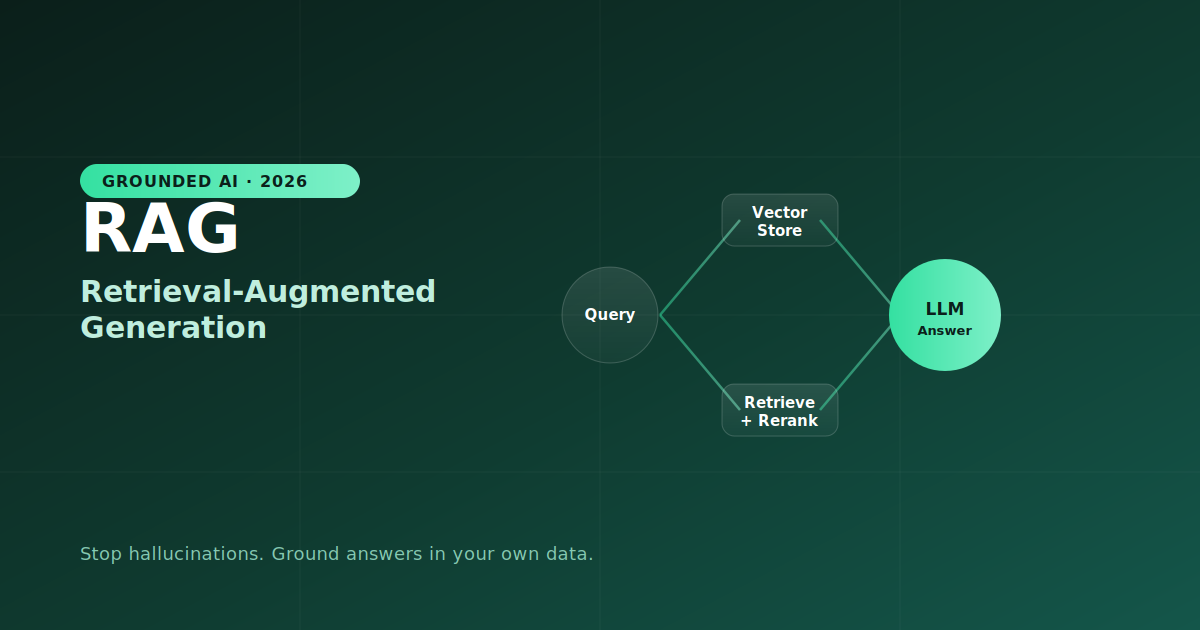
Retrieval-Augmented Generation (RAG) is the most practical fix. Instead of relying only on what a model memorized, a RAG system retrieves the most relevant, up-to-date documents from a trusted knowledge base and feeds them to the model as context before it answers. The result is accurate, source-grounded, explainable output.
This guide covers what RAG is, how the pipeline works end to end, where it breaks, and the upgrades that actually move quality in production.
Why RAG Exists: Three Problems It Solves
RAG directly addresses three failure modes of raw LLMs:
- Made-up answers (hallucinations). Grounding responses in retrieved evidence reduces the model's tendency to fabricate facts.
- Stale training data. Retrieval injects current information the model never saw during training.
- Missing private knowledge. Your internal docs, databases, and repositories live in systems the base model has no access to.
Crucially, RAG is more scalable and cost-efficient than constantly fine-tuning a model — especially when your knowledge changes regularly. Retraining on every update is expensive; updating a document in a vector store is not.
How a RAG System Works: The Full Pipeline
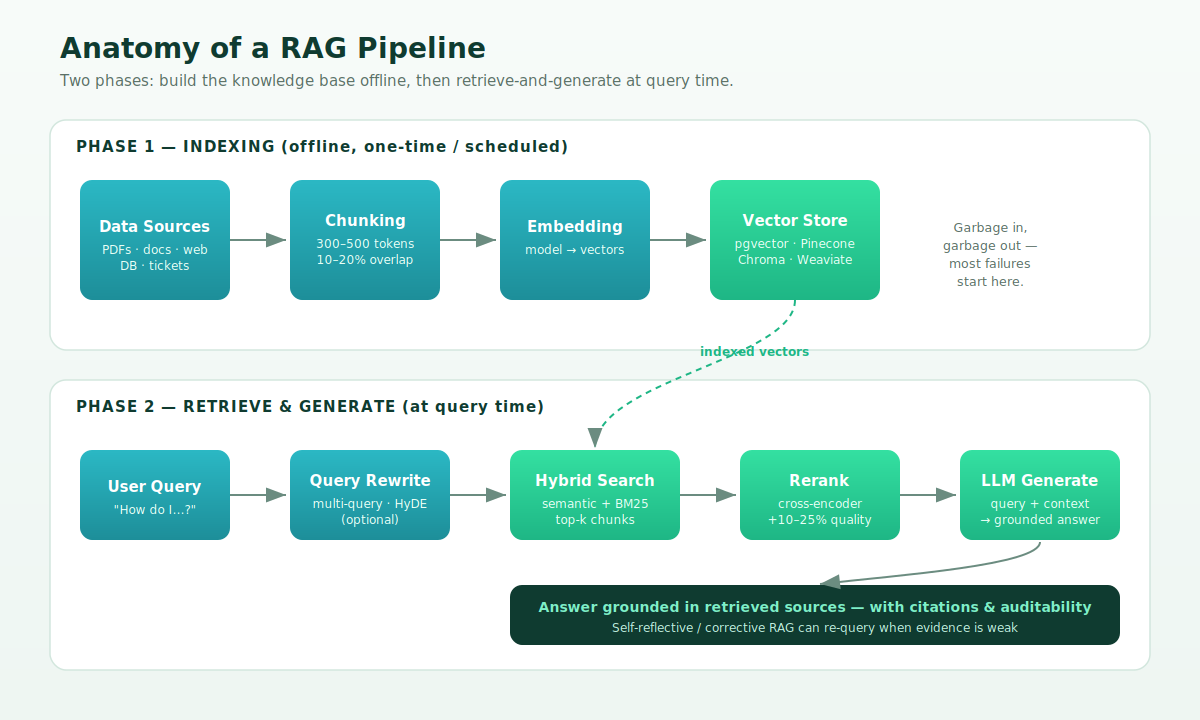
A RAG system runs in two phases. The first builds your searchable knowledge base offline. The second answers questions at query time.
Phase 1 — Indexing (offline)
This phase transforms raw data into a searchable format. It runs once up front and then on a schedule as data changes.
- Data ingestion. Collect raw, unstructured content — PDFs, web pages, internal reports, database records, support tickets — into a single source of truth.
- Chunking. Split documents into smaller passages. A common starting point is 300–500 token chunks with 10–20% overlap, so context isn't sliced awkwardly across boundaries.
- Embedding. Convert each chunk into a numeric vector using an embedding model. Domain-tuned embeddings noticeably improve precision on enterprise data.
- Storage. Load those vectors into a vector database — pgvector, Pinecone, Chroma, or Weaviate are common choices — where they can be searched by similarity.
Phase 2 — Retrieve and Generate (at query time)
- Query (optionally rewritten). The user's question can be expanded for better recall — generating multiple paraphrases (multi-query) or a hypothetical answer document to embed (HyDE). Different phrasings hit different vocabulary, reducing lexical mismatch.
- Retrieval. The system finds the most relevant chunks. Hybrid search — combining semantic vector search with keyword search like BM25 — often beats vector-only retrieval because it catches both meaning and exact terms.
- Reranking. A second model (a cross-encoder) re-scores the retrieved chunks so the best context rises to the top.
- Generation. The model receives the original query plus the retrieved context and produces an answer grounded in that evidence — ideally with citations back to the source.
The Single Best Upgrade: Reranking
If you only improve one thing in a production RAG pipeline, make it reranking. Adding a cross-encoder reranker is repeatedly cited as the highest-leverage upgrade, often improving answer quality by roughly 10–25% for only 50–200 ms of added latency. It's a small architectural change with an outsized payoff.
Where RAG Systems Fail (and It's Usually Not the Model)
A hard-won lesson: most quality issues start before generation. Bad PDF parsing, weak chunking, poor metadata filters, and low-quality retrieval do more damage than the LLM itself. The fix order is almost always the same:
- Fix ingestion first (clean parsing, sensible chunks).
- Then fix retrieval (hybrid search, reranking, query rewriting).
- Only then worry about generation.
Another common misconception worth correcting: long context windows do not eliminate the need for retrieval. In practice, usable context is often only 25–50% of the stated limit, and stuffing every possibly-relevant chunk into one giant prompt degrades quality and cost. Targeted retrieval still beats brute force.
RAG vs. Fine-Tuning: Different Jobs
These are not competitors — they solve different problems:
- RAG handles changing facts and private knowledge. Use it when your app needs current, specific, or proprietary information with source attribution.
- Fine-tuning handles behavior, tone, and output format — how the model should respond, not what it knows.
There's also a hybrid: RAFT (retrieval-augmented fine-tuning) trains a model to reason over retrieved documents in a domain-specific way, capturing fine-tuning's stylistic benefits while keeping retrieval's knowledge freshness and auditability.
What's New in 2026: Agentic and Self-Correcting RAG
The frontier has moved beyond the simple "retrieve-then-generate" loop:
- Agentic RAG embeds retrieval inside multi-agent systems, where specialized agents handle query decomposition, retrieval, validation, and synthesis in parallel. This is the dominant emerging pattern for enterprise AI agents.
- Self-reflective and corrective RAG let the model evaluate its own retrievals and outputs, re-querying when the evidence is weak or the answer lacks confidence — substantially reducing hallucinations in high-stakes domains.
- Governance-first RAG. Enterprise pipelines increasingly layer access controls, metadata, and policy checks before retrieval, so only authorized, high-quality information ever reaches the model.
When Should You Use RAG?
Reach for RAG when your application needs to pull from data that changes often or lives in private systems the model never saw during training. It's the go-to architecture for knowledge assistants, document Q&A, and support bots — anywhere accuracy, source attribution, and auditability matter.
The Bottom Line
A RAG system is, at its core, a disciplined way to give an LLM just-in-time access to the right context at the moment it answers. The model stays general; your data stays current and private; and the answer comes back grounded in verifiable evidence. Get the unglamorous parts right — clean ingestion, smart chunking, hybrid retrieval, and a reranker — and RAG turns a confident guesser into a reliable, citable assistant.
Architecture diagram and concepts reflect production RAG practices as of 2026. Tooling versions and model choices evolve quickly — always check current documentation for your chosen vector database and frameworks.