Best AI Models in 2026: The Honest, Task-by-Task Ranking
If you came here looking for the single best AI model of 2026, here's the uncomfortable truth: that question is dead. There are now over 40 serious models from four major providers, and none of them wins everything. In March 2026 alone, more than a dozen significant releases dropped in a single week, and the leaderboard changed hands multiple times inside a 26-day window.
So the modern answer isn't a winner — it's a matrix. Below is where the frontier actually stands, organized by what you're trying to do, with the benchmark evidence behind each call.
The Defining Feature of 2026: Specialization
A year ago you could plausibly route every task through one model. In 2026 that's the biggest mistake teams make. The frontier has split into task-specific winners, and the developers and teams winning with AI are routing intelligently — one model for code review, another for research synthesis, another for customer-facing replies, and a cheap open-weight model for high-volume background work.
Here's the landscape, model by model.
Claude (Anthropic) — Best for Coding, Writing, and Agents
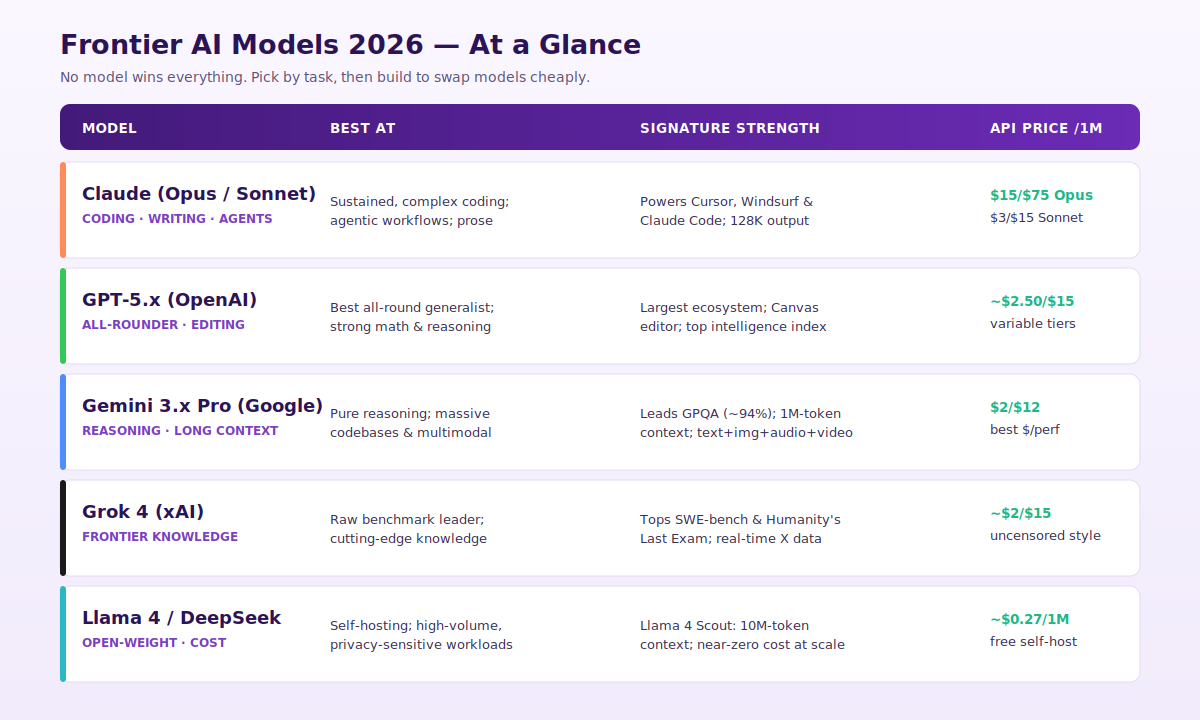
Claude's strength isn't a single benchmark line — it's the ecosystem and the consistency. It powers Cursor, Windsurf, and Claude Code, the three tools most professional developers reach for daily, which says more than any leaderboard. On real GitHub-issue resolution it has repeatedly traded the top spot on SWE-bench-style coding evals, and for sustained, multi-file engineering tasks it's widely rated the most reliable.
For writing, little else competes: it produces the most natural prose and can generate up to 128K tokens in a single pass, useful for long-form documents. And it has the strongest agentic story in 2026 — persistent coding sessions that hold state, touch the file system, and execute commands, supported by the MCP/ACP protocols.
The catch is price. Opus-tier runs around $15/$75 per million tokens, while Sonnet-tier delivers near-Opus quality at roughly $3/$15 — the value sweet spot for most production coding.
- Use it when: You write code most of the day, need autonomous agents, or want publication-grade writing.
GPT-5.x (OpenAI) — Best All-Round Generalist
GPT is the model that made AI mainstream, and in 2026 it remains the best all-rounder with the largest ecosystem — the deepest pool of prompt guides, integrations, and third-party tooling. The latest generation rebuilt the base architecture and currently leads composite "intelligence index" rankings, with very strong math and reasoning scores.
For writing workflows, its Canvas editor is widely considered the best editing environment — many teams draft elsewhere and polish in Canvas. Pricing sits around $2.50/$15 per million tokens, though higher reasoning tiers get expensive and variable enough that you should cost-model before production.
- Use it when: You want one dependable model for mixed work, the biggest ecosystem, or the best editing surface.
Gemini 3.x Pro (Google) — Best for Reasoning and Long Context
Gemini is the price-to-performance leader at the frontier. It leads published reasoning benchmarks — around 94% on GPQA Diamond (graduate-level science) and a large jump on memorization-proof reasoning tests — at just $2/$12 per million tokens.
Its other superpower is context. Gemini accepts text, images, audio, video, and code in a single 1-million-token window, making it the natural choice when you need to load an entire codebase, a full legal contract, or a large research corpus at once. A Flash variant delivers near-Pro intelligence at dramatically lower cost for high-volume tasks.
- Use it when: You need deep reasoning, multimodal inputs, or to reason over a massive codebase or document in one pass.
Grok 4 (xAI) — Best for Raw Benchmarks and Frontier Knowledge
Grok tends to top the raw leaderboards — leading SWE-bench scores and Humanity's Last Exam, the hardest frontier-knowledge test. It also offers real-time access to X data and a more uncensored response style. If your work touches cutting-edge scientific knowledge at the absolute frontier, Grok is worth testing specifically for that.
- Use it when: You want the highest raw benchmark scores or real-time, frontier-knowledge research.
Llama 4 / DeepSeek — Best for Open Weights, Privacy, and Cost
The open-weight tier is where the cost floor collapsed. DeepSeek is free to self-host (MIT license) or roughly $0.27 per million tokens via API. Llama 4 is impressive for an open model — Llama 4 Scout ships a staggering 10M-token context window, more than anything closed-source — and once you self-host on your own GPUs, the per-token cost drops toward zero. Neither quite matches the closed frontier on the very hardest tasks, but for regulated, high-volume, or privacy-sensitive workloads they're often the right call.
- Use it when: You need self-hosting, data residency, or the best economics at scale.
A Quick Decision Tree
- You code most of the day → Claude (ecosystem + agents) or Grok (raw scores).
- You write or edit long documents → draft in Claude, polish in GPT Canvas.
- You need deep reasoning or huge context → Gemini Pro.
- You run high-volume or regulated workloads → self-hosted Llama or DeepSeek.
- You want one safe default → GPT-5.x.
Two Warnings Worth Internalizing
First, reasoning models hallucinate more, not less. Every major reasoning model tested in 2026 exceeded a 10% hallucination rate on standard datasets. More "thinking" does not automatically mean more truthful — verification still matters, especially in high-stakes domains.
Second, don't hardcode your app to one provider. When new models ship every few weeks and the #1 spot changes hands multiple times a month, applications locked to a single model face recurring, expensive migration projects. Model-agnostic infrastructure is no longer optional.
The Bottom Line
There is no best AI model in 2026 — there are task-specific champions: Claude for coding, agents, and prose; GPT for all-round work and editing; Gemini for reasoning and long context; Grok for raw frontier knowledge; Llama and DeepSeek for open, cheap, private deployment. The winning strategy isn't picking one. It's picking the right model for each task and building the architecture to swap them cheaply.
Model names, benchmark figures, and pricing reflect reporting from early-to-mid 2026 and shift almost weekly — verify current specs and rates with each provider before committing to production.